The Nissan Leaf is an all electric car for the masses. On paper, the car seems to be a much more realistic proposition than cars like the Tesla or the Fisker. It’s a small 5 seat car, with a range of 100 miles and a target price somewhere a bit above $25k. For many, this is a price point that is manageable, even in these tough times.
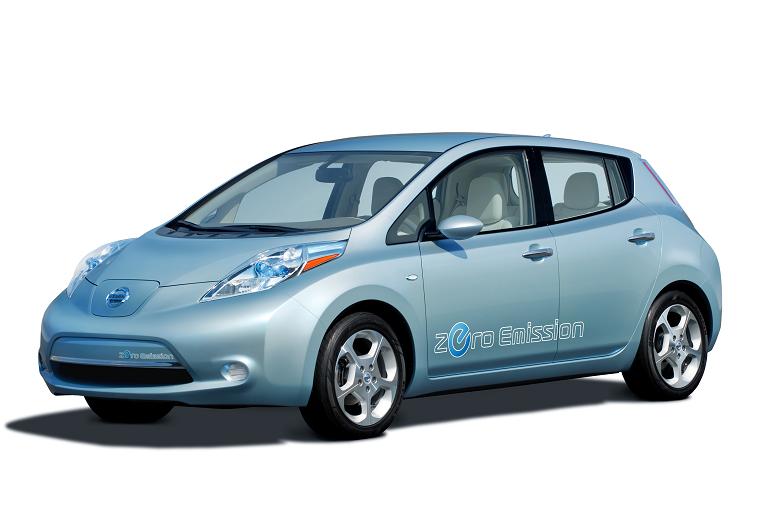
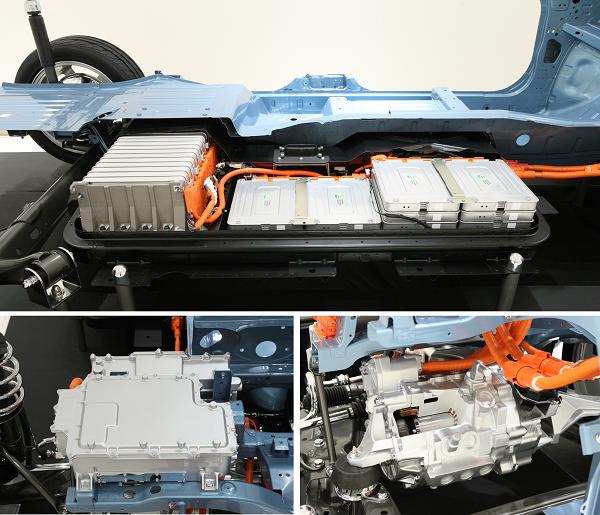
Now, Nissan did a rush program to get the car to market. While the marketing campaign is in full swing, there are really just two Leafs in the world! One is right hand drive, and one is left hand drive. There are also 5 test mules based on sliced and diced Versa. Drawn and quartered (literally) to make a car a bit longer and wider that house drive-trains for testing and media events (part of the Nissan Leaf Zero Emission Tour) like the one I attended.

I’ve driven the GM EV1before so I wasn’t a total electric car virgin, and the Leaf test mules are what you’d expect. More torque than you’d think, and near silent operation. If you’ve ever driven a Prius, starting is very similar: you move a little lever over and down to put the car in drive, and the only way to know it’s on is the lights on the dash. Oh yeah, and when you push the “gas” pedal the car goes.
The test drive was uneventful. But that’s good news. The car did what it was supposed to do, and did it well. Really, for a rush program, I commend Nissan. The mule I drove didn’t share a dash or interior with Leaf show cars, but the drive-train was what we’d get in the car when released, and the drive train was just fine.

Really, this is the car my Mom wants to own! She’s been jonesing for an all electric ever since GM took her EV-1 back (a very sad day for her). While she likes her Prius, she really wants an electric. And this would do everything she needs from a car and more.
What was much more interesting than the actual driving experience was some of the discussions happening around the ride and drive. I spent some time talking to Scott Stevens, VP of Corporate Communications – Americas for Nissan and three other electric car zealots who’s names I didn’t get (sorry guys).
Since I’m just a lowly physicists, I just listened for a while. Two (or three) of the electric car owners have the wonderful Toyota Rav4 electricand have been driving them for years. One of them was pushing the concept of selling the pluses of electric drive-trains (no stopping at gas stations) as opposed to trying to mitigate the ever present range anxiety. After listening to this for a bit, I turned the direction of the discussion a bit and asked Scott what he thought the major challenges faced Nissan in launching an all electric.
- Range. People want the same range as a tank of gas, and it’s just not there yet.
- Price. The Tesla roadster is a very nice showcase, but at $100k+, it’s not a car for the masses.
- Change anxiety. This is the real tough nut. Change brings fear due to uncertainty and lack of understanding. This is the real barrier to adoption.
Really, the Leaf nails the first two, although most people don’t realize it. This graphic shows what percentage of miles traveled as a function of daily miles driven:

So almost 70% of days 100 mile range is enough. To be fair, not everyone who travels 100 miles or less one day drives 100 miles or less the next, but many do. Also for those that don’t, many are not single car families, so if 100 miles isn’t enough on a given day, the longer range vehicle can be used. This type of vehicle use selection happens in my own home. We have a 2001 Acura MDX that is parked most of the time, only being driven when we need the capacity. Our two Mini Coopers get the day to day driving duties.
The cost issue is just one of perspective. Yes the Leaf has a bit of a premium over equivalent gas powered vehicles (new tech, no economies of scale to speak of yet), but then, it should have a significant reduction in cost per mile driven once purchased. As an example, when my mom drove her EV1, that had a cost per mile of less than 2 cents! If one uses $3/gal gas as a price benchmark, that’s greater than 150 miles per gallon using price equivalence. As gas prices go up, this effective MPG gets even more favorable!

Ownership costs using these metrics are very use dependant, but what it comes down to is that the more you drive an electric, the greater the savings. But no matter how much one drives the car, $25k is an approachable price point for pretty much all buyers.
Change anxiety is the largest barrier remaining. We’re all used to driving gas vehicles and doing weekly or twice a month stops at gas stations. We’re not all used to electric and nightly charging. This is the “tough nut to crack” for electric vehicle manufacturers and for this one, there is no magic bullet.
So, back to the conversations. There were some real suggestions that came from the discussion.
- Many dealers don’t want to deal with the hassle that doing a new type of sell require. there were several stories about how dealerships with electric cars would say “yeah that’s coming, but we’ve got this gas car right now, so buy it” or some variant. So we suggested to Scott to make sure to pay a premium commission to the sales force to move the electric cars. Incentives work on sellers, not just customers!
- A recent limited roll outs of electric Mini Coopers found that the biggest barrier wasn’t the very high (>$800/month) lease costs nor the limited range (~120 miles), but was the hodge-podge of permitting and approvals to get electric chargers installed in the home! Who wants to buy a car then have to wait 8 weeks while some inspector looks over some new wiring in the garage? So the dealerships have to help the buyer understand what they’re getting into, and help lower the difficulty of navigating the local regulations and the like. This dove-tailed with the last suggestion:
- Have an electric vehicle expert at each and every dealership that is selling electric cars. These people would be able to help with the issues outlined above, as well as education BOTH the staff and the customers about the pros and cons of electric vehicle ownership so that the right product can end up in the hands of the right customer.
Overall, the event was a good one to participate in. I got some seat time with one of the new all-electrics, got to meet some who are involved in the launch, and even learned a thing or two!
Also, this meeting was the Holiday meeting of the Western Automotive Journalists, and was underwritten by Nissan (thanks guys!). Not only did I get to enjoy a nice meal, but I won a bottle of wine in the raffle! (Gave that one to the wife for me leaving her with our two kids). Anyway, it was a nice evening, thanks to all who made it happen.
Share This:


It’s great to see that there are more alternatives in the pipeline. However, I keep seeing one basic issue that is consistently overlooked in everything I read. That being access to recharge sources. Sure, I live in a nice community in the suburbs and have a garage where I could easily plug in such a vehicle. My trips are for the most under 100 miles so range is not an issue at this time for day to day use. but, what is the apartment dweller to do. Until the management companies of these types of housing see the need to provide recharging stations in parking areas and city dwellers can also find access to easy to use recharging adoption rates for all electric vehicles will be low.
I also think the charging needs to be optimized for the standard 110V outlets we all have. I think the ideal will be the ability to fully recharge at a 110V source within 1 hour. A lofty goal but one I think is important for the mass to adopt such a vehicle.
Thanks for posting! Yes you raise some valid concerns and I’ll try to address some of them. Access to recharge is an issue, it’s also a bit of a chicken and egg thing. Nissan just announced today that they’re going to launch first in the SF bay area, mostly because of Mayor Gavin Newsoms committment to electric infrastructure for charging. There are other cities that are doing that as well, both here and abroad. The issue of multi-unit dwellings is a valid concern as well. Some places will provide for it early, some may never. I’m sure it will depend a lot on the vision of the building owners and the demands of the residents. What this really means is that electric cars won’t be a good solution for as much of the market space when they are introduced as when the market matures (pretty much true for any emerging technology).
1 hour at 110V is never going to happen. It takes between 10kW and 20kW to sustain 60mph. If you do the math on that it’s just too much current to pump out of a 110 V connection. That’s why you see two charging times for most cars. But that doesn’t mean you can’t get a boost from household AC when your not at your charger. The Leaf has two electrical plugs (although I don’t know what they are) I’d guess one is for AC. think of this as range extension even if not capable of a complete charge while you shop or watch a movie.
Matt
I was always wondering what all-electric car manufacturers think about cold climates? In the gas cars natually heat from the engine warms up cabin. What about electric cars? Wouldn’t installation of the heater be a really drag on the range? Wouldn’t it be easier to have small gas engine which would drive all utility functions – A/C, power steering, provide heat in winter, generator to recharge batteries. In this case you really don’t need more then reliable 1-2 cylinder 4-stroke engine, hopefully bigger range, and you can still recharge by just running the gas engine. 10 gallon tank would most likely last month or even longer. Plus you can choose to run that engine or not and if overnight charge is enough and you can live without A/C or heat particular day
While we’re discussing the Driving the Nissan Leaf : Dr Obnxs' Musings, issue, Whenever possible, combine your errands and plan your route in advance, so you do less driving. You may not increase your fuel efficiency, but you’ll reduce the environmental impact by using less gas.