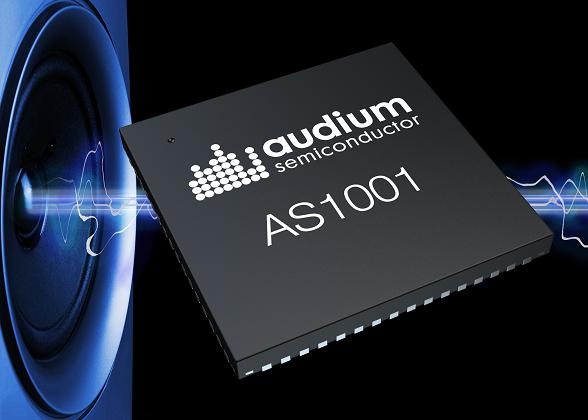
It’s amazing what application specific integrated circuits can do now. I never stop being surprised at what I keep seeing coming out of the pipeline. Audium Semiconductor recently gave me one such surprise with the hyper efficient AS1001 amplifier that can deliver 100 watts peak power, from a 1.5 volt (read single battery) power supply.
This is really cool, because it means more oomph from battery powered devices. Audium claims that this little sucker can run for about 1000 hours on 4 C batteries. That’s about 10 months at 3 hours of listening per day!
Stepping back a bit, I’m a physicist by training. Most of us (except for the theoriticians) made some or all of our electronics as we learned our trade, and that meant that we knew all about power and distortion. This also meant that we liked really good stereo equipment that made true representations of what was pressed into our Mobile Fidelity Sound Labs master recordings of Dark Side of the Moon and the like.
This meant class A amplifiers, and for the really persnikity, tube amplifiers (for their richer sound at high volume, and gentle non-linearities as one hit saturation. Anyway, these things were power hogs and could heat the room even when doing nothing. Solid state amplifiers were looked down on, mostly because of how they distorted music as the crossed zero volts out. This sucked because all amplifiers cross zero at all volumes (Except for our friend the class A amp), so cheap solid state amps sounded bad, even when not being pushed.
But that’s not the case any more! Solid state amplifiers are now good, really good. (The highest end of the market is still the land of the Class A tube amp, but the size of this market keeps shrinking because of the advances in solid state analog electronics and the ever increasing price of the top of the line audio equipment). Signal reproduction is now so good in solid state products, that efficiency in one of the main areas of competition. This brings us to the class D amplifier. Class D amplifiers are kind of a cross between amplifiers and switching power supplies, but the details are unimportant. What is important is by using tricks with high speed switching of transistors (so they are either fully on or fully off), they are much more power efficient than “analog” waveform amplification. This is good for two reasons. One less power for the same volume is always good, and all the audio equipment is now just computers anyway, so getting closer to the binary world of CPUs makes integration easier.
The Audium product takes the Class D power efficiency and puts it to shame. As far as I can tell from what I can figure out from their web site, they do this by some form of “rail switching” where the internal power supplies of the chip only output high voltages when the amplifier needs them. Kind of switching squared…..

The AS1001 is currently available in a 64 pin QFN package. For those not in the biz, that’s something less than 1 cm on a side, and about 1 mm tall! Compare that to a vacuum tube and it’s a tiny fraction of the space. The size and efficinecy means this chip is perfect for boom boxes, or wireless speakers that really are wireless because they don’t have to be plugged into the wall.

Anyway, what does this really mean? In green terms, it means a lot less batteries. (For details on the impact of batteries, look here.) But really, whether one uses disposable or rechargable batteries, it means using a lot less of them. And that’s a very, very good thing.
Share This:


So, in my inbox today, just a minute ago, I got this:
NXT acquires Audium Semiconductor’s IP to create 25W-per-channel USB-powered loudspeaker platforms
NXT plc, a provider of unique sound and touch solutions, best known for its flat panel loudspeaker technology, today announces the strategic purchase of the intellectual property of Audium Semiconductor and associated assets.
NXT intends to use Audium integrated circuits to provide customers with complete audio platforms incorporating its proven Balanced Mode Radiator (BMR) technology together with ultra-efficient power amplifiers. NXT customers should then be able to create compact, USB-powered loudspeakers capable of delivering 25 Watts peak-per-channel.
Balanced Mode Radiators combine NXT’s flat panel expertise, and the desirable attributes of conventional speaker technology, in a single drive unit. The result is a wide bandwidth, wide directivity speaker where no crossover components or frequency-specific drivers are required. Available in a range of compact form factors, acoustic engineers and designers benefit from the esoteric flexibility as the driver can be used as a cosmetic feature or hidden completely, in addition to cost savings delivered through fewer components.
The Audium amplifier chip can be 20 times more efficient than competing devices, thanks to patented techniques that minimize both fixed power losses and output-dependant variable power losses. The chips use power rail switching so that the amplifier operates efficiently from a low voltage supply most of the time but an on-chip DC-DC boost converter drives its output transistors on audio peaks. The amplifier chips include integral filtering, enabling them to be optimized for each application.
The combination of technologies could enable rapid development of compact, high-power, active loudspeakers. The audio signal and power will be driven from a single USB port with no other power source required.
In the first instance the Company is developing a reference platform design incorporating BMR drivers and the amplifier chips.
**********************
Anyway, I guess I wasn’t the only one that noticed how cool the new tech is.
Matt